NOVA’s Center for Responsible AI in Victim Services supports victim advocates, organizations, and allied professionals as they navigate the growing impact of artificial intelligence on victim services.
The Center is designed to support the field in better understanding the opportunities, limitations, risks, and real-world implications of AI in victim services. Through training, tools, policy guidance, research, and collaborative dialogues, NOVA aims to support informed decision-making while reinforcing the importance of human judgment, survivor trust, and ethical practice.
National Advisory Council on AI in Victim Services
The National Advisory Council on AI in Victim Services comprises multidisciplinary professionals from various fields, including victim services, advocacy, ethics, technology, research, law, and related areas. Its purpose is to inform the development of the Center for Responsible AI in Victim Services and foster thoughtful, survivor-centered conversations about the role of AI in victim services.
Committee Members:
Kaylyn Ahn
Researcher, Oxford Institute for Technology
Jessica Beckman
Program Manager, International Association of Chiefs of Police
Timothy Beres
Executive Vice President, Institute for Public Research at CNA
Cailin Crockett
Policy Expert and Strategist on Online Safety and AI
Adam Dodge
Founder, EndTab
Meg Garvin, MA, JD, Mst
Executive Director, National Crime Victim Law Institute (NCVLI)
Aviv Landau, PhD, MSW
University of Pennsylvania, Co-Director of SAFElab
Allison Randall
Vice President of Government Affairs,
National Domestic Violence Hotline
Kristina Rose
Former Director of the Office for Victims of Crime (OVC)
Chad Sniffen
Director of Digital Experience and Safety, metoo. International
Belle Torek, Esq.
Technology Safety Specialist, NNEDV’s Safety Net Project
Gloria Terry
CEO, Texas Council on Family Violence
Emily Wright, Ph.D.
Senior Research Fellow, Urban Institute Justice and Policy Center
Exploring AI Tech in Victim Services
Artificial intelligence is already influencing how victim services are delivered, how survivors access information, and how organizations respond to emerging challenges. The tools below represent examples of technologies currently being explored or used in areas such as safety planning, crisis response, documentation, and digital safety. These examples are provided to help victim advocates understand how AI may be applied in the field and to encourage thoughtful discussion about opportunities, limitations, and ethical considerations when evaluating technology for use in victim services. The inclusion of a tool or platform does not constitute endorsement by NOVA and is intended to support awareness and learning about emerging practices.
Aimee Says is a trauma-informed AI support system designed to help survivors of domestic violence access safety planning guidance, documentation assistance, and information about available resources.
Ruth is an AI tool that helps survivors by providing a secure way to record their experience, document incidents of abuse, and access information about safety and support services.
Enhanced Virtual Victim Assistant (EVVA) is an AI-powered chatbot designed to bridge the gap between police departments and victims of crime by answering common questions asked to law enforcement, such as how to obtain a police report or check the status of the case.
JusticeText is an AI-powered transcription and analysis platform used by legal professionals to review and organize audio and video evidence. The technology is increasingly used in cases involving domestic violence and other crimes to help identify patterns and support case preparation.
HopeChat is an AI assistant to help survivors, advocates, and allies quickly access local resources on domesticshelters.org with sensitivity and privacy.
The Automated Intimate Partner Violence Risk Support (AIRS) System analyzes electronic medical records, including radiological images, to identify potential IPV victims, developed through several years of research on hospital data. Read more: https://www.nih.gov/news-events/news-releases/researchers-develop-ai-tool-predict-patients-risk-intimate-partner-violence
SimLap VR Platform is a virtual reality training tool that prepares victims and advocates for courtroom experiences through immersive, trauma-informed simulations.
Events
Organizational Tools
These free tools are designed to help victim service organizations thoughtfully assess, plan, and implement AI in ways that prioritize ethics, safety, and survivor-centered practice.
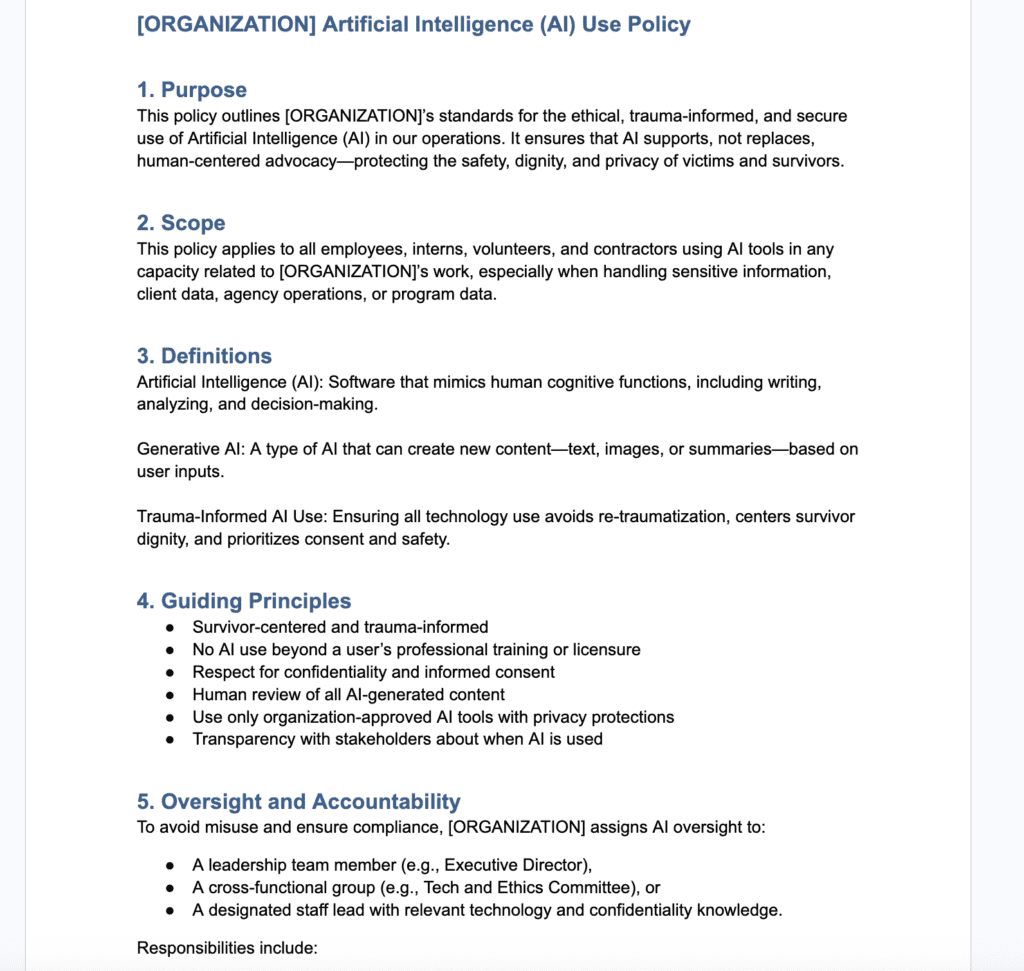
Organizational Policy Template
AI Readiness Survey
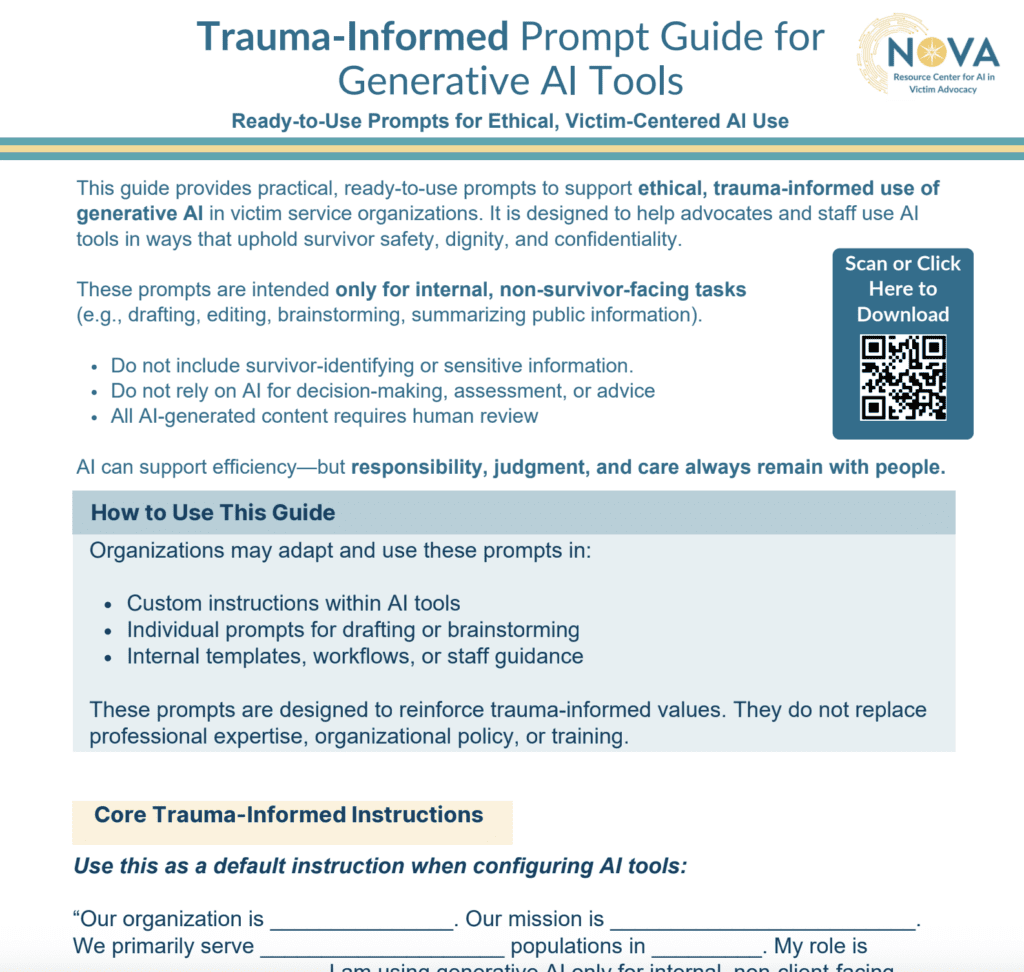
Trauma-Informed Prompt Guide for Generative AI Tools
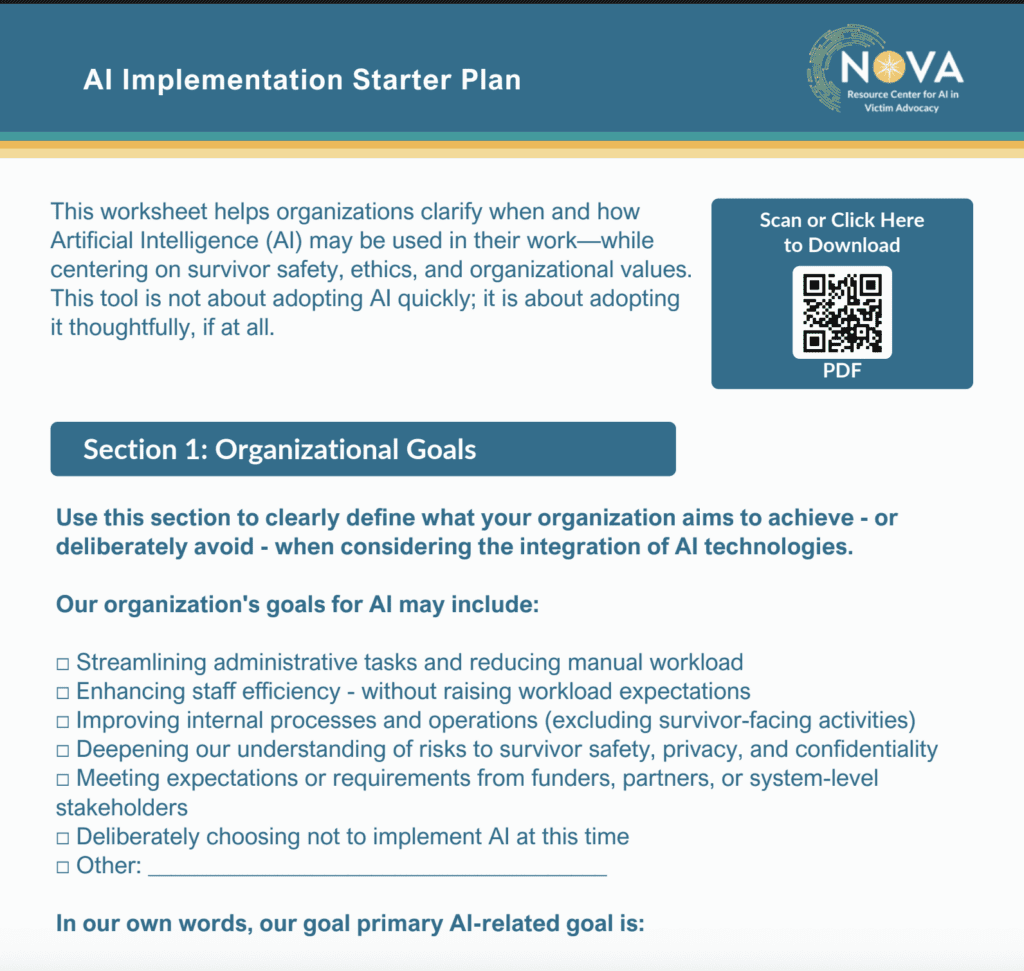
AI Implementation
Starter Plan
A practical guide with ready-to-use prompts that help staff use generative AI tools in ways that prioritize survivor safety, confidentiality, and trauma-informed language.
A structured worksheet that helps organizations think through goals, guardrails, training needs, and oversight before introducing AI tools into their work.
Additional Tools:
AI in the Field
How is AI being used to enhance victim services? What are the implications and outcomes of these implementations? How can we ensure that these services remain survivor-centered? These resources describe how AI is being applied in victim services and what the future may hold.
Detecting Risk of Family Violence Using AI
AI and Gender Based Violence in low and Middle-Income Countries
AI to identify and predict human trafficking hot spots
AI and Advocacy: Maximizing Potential, Minimizing Risk
AI Training and Education on Child Abuse
Joy-Informed AI
Canada's Launch of the First AI Register
Elder Abuse Using AI
AI and Implications on Victims
Deepfakes and the Impact on Schools and Campuses
Adopting a trauma-informed and responsive justice framework
AI-Facilitated Coercive Control: An Experimental Study
Conversations on Ethics, AI, and Advocacy
The Conversations on Ethics, AI, and Advocacy series is part of NOVA’s Resource Center on AI in Victim Services. These conversations highlight the people behind emerging technologies that intersect with victim advocacy, survivor support, and technology-facilitated harm.
Each episode offers a brief, human-centered look at how tools are being developed, the values guiding that work, and the real-world implications for survivor safety, privacy, and trust.
Policy, Governance, and Regulation Resources
Click here for an interactive tracker on State and Federal Legislation Activity
NOVA AI Team
Claire Ponder Selib
NOVA Executvive Director
Shannon Collins, LCSW
NOVA Associate Executive Director
María Cristina Pacheco Alcalá MPsy
NOVA Senior Director of Training and Technical Assistance
Kimberly Henry, LMSW
NOVA Senior Military Coordinated Community Response Program Manager
Get Involved
NOVA invites advocates, organizations, and partners to contribute to the ongoing development of this resource center. Share tools, research, and promising practices – or join us in shaping ethical, survivor-centered approaches to AI in victim services.
Frequently Asked Questions
Artificial Intelligence (AI) refers to computer-based systems that can perform tasks such as generating text, summarizing information, or identifying patterns accross data.
What it is not: AI is not a human decision-maker. It does not hold lived experience, cultural context, or an understanding of trauma. It cannot interpret nuance, assess safety, or build trust. AI should never replace the professional judgment, ethical responsibility, and relational practice that are foundational to victim advocacy.
Safety depends on how – and whether – AI is used.
AI may be appropriate for limited, low-risk administrative tasks, such as drafting general content or summarizing publicly available information. However, any use involving survivor information, case details, or safety planning introduces significant risk and requires careful consideration.
Responsible use requires intentionality, transparency, and accountability – not rapid or unexamined adoption.
Organizations are encouraged to:
Establish clear boundaries for when and how AI may be used
Protect confidentiality by prohibiting the input of any personally identifying or sensitive survivor information
Ensure human oversight in all applicants, with final decision-making grounded in professional expertise.
Engage in ongoing training and critical reflection on ethical implications, bias, and potential harm
Center survivor autonomy and choice, including transparency when AI is used in any capacity.
NOVA offers tools, training, and technical assistance to support organizations in developing thoughtful survivor-centered approaches to emerging technology. For this information, contact [email protected]
The use of AI in victim services introduces several critical risks that must be carefully weighed:
Confidentiality and privacy concerns, including potential data exposure or misuse
Lack of comprehensive regulation and enforceable protections, particularly in sensitive service contexts
Bias and inequity, which may reinforce systemic harm or disproportionately impact marginalized communities
Limited transparency makes it difficult to understand how outputs are generated or how decisions are influenced
Overreliance on AI, which can determine professional judgment and survivor-centered practice
A trauma-informed, ethical framework requires organizations to ask not only “Can we use this?” but “Should we – and at what cost?”
No. NOVA does not endorse, certify, or recommend specific AI tools or platforms.
NOVA’s Resource Center is designed to support organizations in building critical awareness, strengthening ethical decision-making, and prioritizing survivor safety and dignity in all technology use.
Each organization is responsible for determining what aligns with its own policies, legal obligations, and commitment to survivor-centered, trauma-informed care.
*Note: Inclusion in NOVA’s Resource Center for AI in Victim Services series does not constitute endorsement, recommendation, or certification. Organizations are responsible for independently evaluating tools, software, and processes in accordance with their policies, funding requirements, and legal obligations.